|
Welcome, all! This new blog is designed to address some of the
many questions I receive regularly from musicians about technical issues. We’ll
cover a variety of topics, and I welcome comments and questions.
First, a quick introduction. I’m Frank, and I am the
founder, owner and president of Studio Sound Electronics. I have
nearly 50 years' experience in amp repair. Although I no longer
repair amplifiers myself, I want to share what knowledge I have gained along the
way. As a bit of background, I earned a bachelor's degree in
electrical engineering in 1970, did graduate course work following that, and
spent 35 years in the telecommunications industry as a senior engineer at
BellSouth and AT&T. During that time, I also began to repair guitar
amplifiers for various music stores in the Louisville, Kentucky area.
I started Studio Sound Electronics in 1997 in order to provide an online source
for technicians and do-it-yourselfers to find the parts they needed to repair
their amps. So, let's get started ...
Dating Vintage Fender Amps
From time to time, I get questions from my customers concerning
the age of their vintage amps. The most frequently asked questions concern
Fender amps from the 50′s up through the 70′s. In most cases, it’s not difficult
to determine the year of manufacturer of most Fender models from those periods.

On the inside wall of your Fender amp cabinet, there may be a
tube location sticker which shows the tube layout, model number, production
location etc. There may also be some letter date codes rubber stamped on this
sticker.
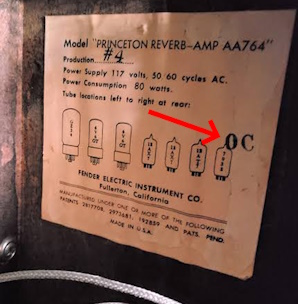
These date codes will contain two letters of the alphabet which
refer to the year and month of production, and may be interpreted as follows:
Code Year
A 1951
B 1952
C 1953
D 1954
E 1955
F 1956
G 1957
H 1958
I 1959
J 1960
K 1961
L 1962
M 1963
N 1964
O 1965
P 1966
Q 1967
R 1968
S 1969
Code Month
A January
B February
C March
D April
E May
F June
G July
H August
I September
J October
K November
L December
So, in the example photo above,
"OC" translates to year 1965, and month of March. Remember,
year comes first, followed by month.
In the absence of the rubber-stamped date codes, EIA numbers
taken from the transformers may allow you to determine the date of production of
your amp. These numbers always begin with “606″ , and are followed by three or
four digits in various combinations. If three digits are present, the first
digit would refer the units of the year i.e. (“7″ would mean 1967). If four
digits are present, the first two digits refer to the year i.e. (“66″ would mean
1966). The last two digits would refer to the week of the year i.e. (“26″ would
mean the 26th week or approximately June). Here is an example: EIA 606-4-21
would mean the 21st week of 1964. It is also advisable to add about 6 months to
the date to allow for time these parts may have spent in storage.
There are other methods used to date “Silverface” amps, you will
need to get the date codes from your speaker frame, tube chart or pots.
Pots and speakers are usually stamped with a 6 or 7 digit code
that can be dated as follows:
The first 3 are the manufacturers code
137xxx = CTS
304xxx = Stackpole
140xxx = Clarostat
134xxx = Centralab
381xxx = Bourns
106xxx = Allen-Bradley
Speaker Manufacturers codes
220xxx = Jensen
465xxx = Oxford
The next number(s) is (are) the year. Initially this was a
single digit, latter that was extended to two digits for clarity.
The last two digits are the week of the year. Note that if these
digits are larger that 52, it probably is NOT a date code!
Thus a pot with the code of 137634 would be a pot made by CTS in
34th week of 1966.
Note that speakers also use the same type of date code.
Always remember that pots, speakers and transformers may have
been changed during a repair!!
For more info, check out these references:
“Fender Amps, the First Fifty Years” by John Teagle and John
Sprung
“How old is that Fender in the Window” by Richard Smith
Fender’s web site – www.fender.com
Until next time, keep on playing on that vintage Fender amp!
|